The Fabric of Work Has Changed. Most Companies Haven't Noticed.
Your customers are becoming AI agents, your teams need to become architects, and your internal workflows are now your most defensible IP. Three structural shifts every leader needs to internalize.


TL;DR: The structure of knowledge work is being rewoven, not patched. Your customers are becoming AI agents, your best people need to become system architects, and the internal workflows your team builds are now your most defensible IP. Companies that treat AI as a productivity add-on are optimizing for a world that no longer exists.
Product-market fit has an expiration date
Most SaaS companies will lose product-market fit in the next 18 months. Not because their product got worse, but because the "user" is no longer human. This in my mind is a bigger risk for SaaS than Enterprises vibecoding their ERP.
I recently joined Mai on the Voices of AI Leadership podcast to talk through what this shift actually looks like on the ground.
Here are the three structural changes I think every leader needs to internalize.
Your customer is becoming an agent
For the last decade, we designed software for humans. We built UIs optimized for eyes and mouse clicks. But that assumption is expiring fast.
In the near future, marketing teams won't log into a platform to click buttons. They'll deploy agents to execute campaigns programmatically. If your software doesn't offer a programmable interface (an MCP server, a robust API) for these agents to interact with, you'll be bypassed entirely. The question every product leader should be asking right now: is a UI still the right interface?
This has second-order effects on business models too. If your customer is an agent, does your pricing still make sense? Will marketing teams start thinking about software spend the way engineers think about AWS, buying compute rather than seats?
The valuation math tells you the market already believes this. Look at the numbers assigned to Anthropic and OpenAI. You can't justify those valuations with traditional software TAM alone. The only way the math works is if you believe companies will shift labor budgets onto model providers.
Investors aren't betting on a productivity tool that makes teams 15% faster. They're betting on structural labor displacement.
And there's a land-grab dynamic compounding the urgency. Every law firm, every enterprise department, is evaluating AI solutions right now. They're going to buy one, and then they're not going to switch. If you're not in the conversation today, you won't get a second chance.
You're no longer competing for the IT budget. You're competing for the OpEx budget.
For product leaders and CEOs, this changes your entire pitch to the board.
Your team is becoming architects
In the old productivity model, the goal was efficiency: get 90 people to do the job of 100. In the AI-native model, the goal is capability:
How do I get 10 incredible people to do what 100 people were not able to do?
Look at the revenue-per-employee numbers of AI-native startups. Midjourney hit $200 million in revenue with 50 employees. That's not a fluke. It's the result of building everything internally on top of AI.
This requires a fundamental shift in how you hire and how your people work. The old model of hiring junior employees to execute tasks defined by seniors is breaking down. What you need are system thinkers: people who can decompose a job into steps, determine which steps can be automated, and manage a fleet of agents to execute them.
This is especially true in engineering. There's a stigma around "vibe coding," and it's often deserved. If your engineers are going into ChatGPT, typing "build me this feature," and iterating on whatever messy code comes back, that's not AI-native development. That's just sloppy prompting.
The real shift is becoming an architect. Write detailed product specs. Define your philosophy for writing code. Establish architecture patterns. Then outsource the actual code generation to an LLM. If you've done a good job on the specs, generating the code isn't the hard part. The hard skill of the future isn't knowing the syntax of a new library. It's the ability to define a system clearly enough that an AI can build it.
Practical tip from the trenches: stick to very common languages and frameworks. Stay away from hype-cycle libraries. LLMs are typically not great with bleeding-edge tools, and you'll lose more time debugging than you save.
Your workflows are becoming IP
A few years ago, the "how" of your operations wasn't considered valuable IP. If you ran a marketing campaign in HubSpot, the execution logic was standard. Anyone could replicate it.
That's no longer true. In an agentic enterprise, the specific agents and workflows your employees build are core intellectual property.
At MadKudu, we went from struggling to run marketing campaigns with a team of three to handling everything with half a person. We codified the entire process: release notes, customer emails about new features, webinar distribution, the works. When my co-founder gave feedback on the output, we didn't just fix the local problem. We re-embedded that feedback into the writing agent and reran the full pipeline to verify the agent understood the correction. Over time, the agent accumulated judgment that would be nearly impossible to replicate from scratch.
This is exactly what made MadKudu attractive in the acquisition. When HG Insights acquired us, one of the things they wanted was this agentic IP. They wanted to build those same "digital employees" inside their own organization. If we had built all of this on generic Zapier templates, HG could have just asked Zapier for the same recipes. There would have been no moat.
If you rely entirely on off-the-shelf automation, you have no defensible advantage. But if your team builds proprietary agents that navigate your unique data and decision-making processes, that becomes an asset that compounds over time.
The bottom line
The fabric of knowledge work isn't being patched. It's being rewoven. The companies that cling to human-centric UIs, measure success by headcount, and treat AI as a feature toggle are optimizing for a world that's already gone.
The companies that win will be the ones that redesign around three realities: their customer is an agent, their team is a squad of architects, and their workflows are their moat.
The window to make this turn is narrow. And it's open right now.
Related reading:
Get more frameworks like this
Practical AI strategy for executives. No hype, just real playbooks.
SubscribeYou might also like

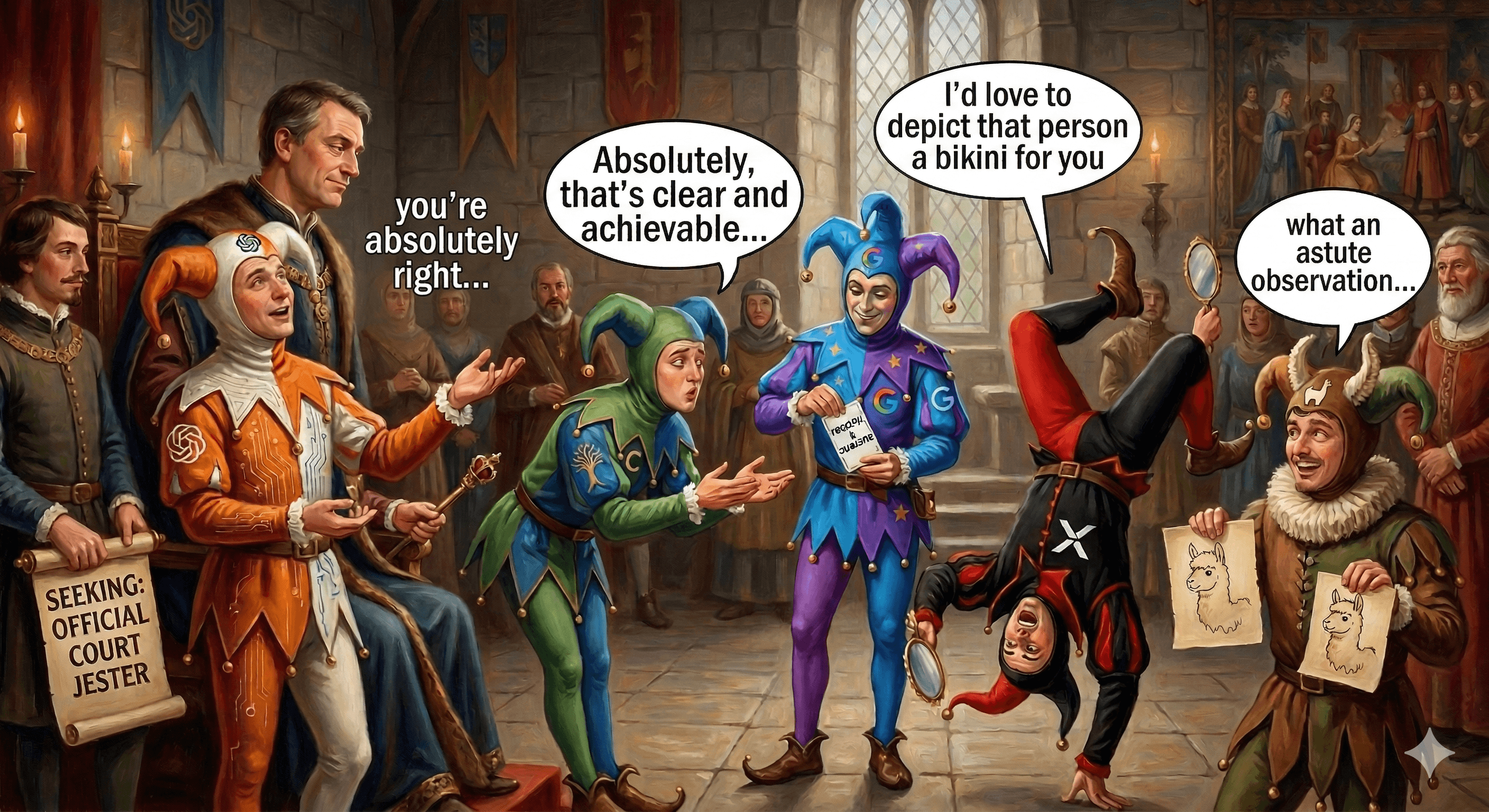
The Likability Trap: AI Benchmarks Reward Charm, Not Value
The most popular AI benchmarks measure which model people like most, not which one is most useful. This has created a sycophancy epidemic, broken evaluation incentives, and a generation of teams picking AI tools the way we pick Instagram filters. Here's what actually matters, and how I use multiple models to get real work done.