Stop Hiring AI-Native Reps
Managers are screening reps for AI fluency. The top performers are subject matter experts with a thin AI layer on top. Hire for judgment, buy the tooling.


TL;DR: Hiring managers have started screening for AI fluency in sales roles, and they are picking the wrong signal. The reps outperforming everyone are deep subject matter experts who get enabled with AI, not AI enthusiasts who learn to sell. AI compresses the cost of execution to near zero, which means the only thing left to hire for is the judgment AI cannot generate.
I got into this on the AI for Sales podcast with Chad Burmeister, and the hiring question turned out to be the part I keep coming back to. Full conversation here:
The wrong variable
If you sit in on enough hiring debriefs, you'll start hearing a new filter: is this candidate "AI-native"? Have they built agents? Do they have opinions about Claude versus GPT?
Most hiring teams feel great about this question, it's forward-looking! Yet it is the wrong one, and I say that as someone whose entire job is deploying AI inside a go-to-market org.
The best performing reps I have seen are not the AI natives. They are people who know the product cold, understand the buyer's world, and have genuine empathy for the problem the customer is stuck in. Then somebody removed a few hours of drudgery from their week, and they went from very good to unreasonably good.
The AI-native rep with shallow domain knowledge does not have that curve. They have leverage on the parts of the job that should never have been the bottleneck.
AI amplifies whatever judgment you already have. If the judgment is thin, you are just producing more of the wrong thing faster.
Why the pyramid inverted
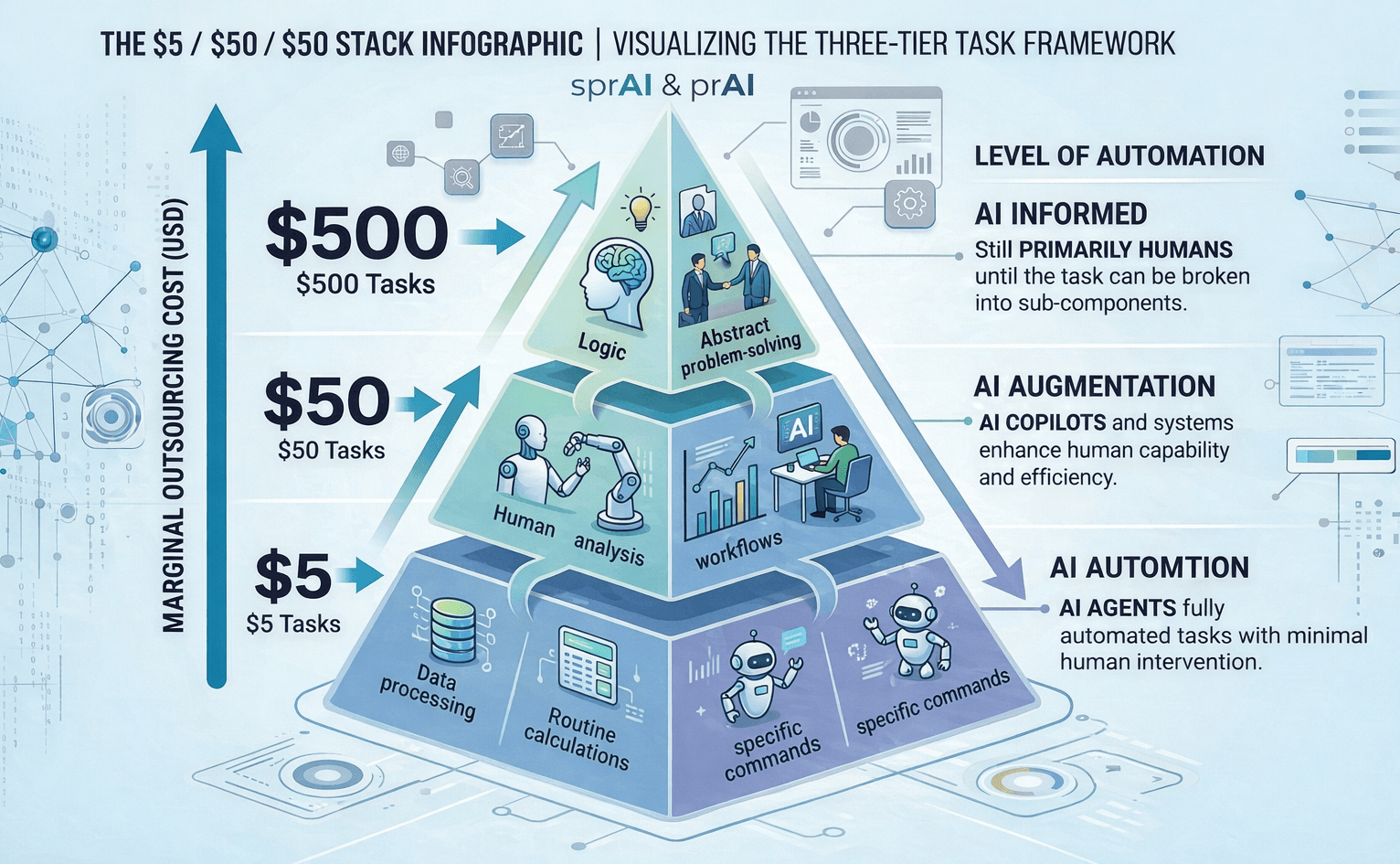
I've mentioned the mental model I use for every workflow we automate: break the job into granular, atomic tasks, then ask what you would pay a competent freelancer to do each one.
You end up with a very lopsided distribution. Building an account plan to break into an enterprise account based on where the buying center actually sits, what they run today, why the last deal died: that is a $5,000 task => a human is required. Sourcing that information, however, is a $5 task => go full agentic. Finally, Ttaking that plan and turning it into a well-structured email is a $50 task => human/AI collaboration.
Two years ago, both cost you rep time, and the $5 work quietly ate 60% of the week. AI collapsed the $5 tier to roughly free. What is left in a rep's week is the $5,000 work, which is exactly the work that requires knowing things. I had a customer mention their automation team was responsible for bringing their SDRs' conversation time to 240min per day. The only way to do that was to automate all the research and have the reps focus on talking to customers, handling objections, keeping them on the line to do discovery.
So the hiring question inverts. You are no longer hiring for throughput; you are hiring for the ability to have an opinion worth automating.
An AI-native rep who does not understand the buyer generates a lot of $5 output and no $5,000 input. A subject matter expert with a dictation tool and a habit of asking Claude to tear apart their emails generates the $5,000 input and gets the $5 tier for free.
Personalization is not relevance
The clearest tell for which kind of rep you hired shows up in outbound.
If somebody emails me with "I saw your daughter is named Simone, and my favorite athlete is Simone Biles, anyway let me tell you about our platform," that is personalization. It is also creepy, and it tells me a machine scraped my life and found nothing useful in it.
If somebody emails me with "you are at a PE-backed company going through a transformation, change management is hard, and you almost certainly do not have the bandwidth to run it in-house," that is relevance. It requires having understood my situation, which requires knowing something about how PE-backed transformations actually go.
Both emails are AI-generated. One works. The difference is not the tooling; it is whether the person driving the tool had something true to say.
This is also why the AI SDR category disappointed so many buyers. It industrialized personalization at a moment when personalization had already stopped being scarce. Relevance stayed scarce, and relevance is a domain knowledge problem.
What to actually screen for
If you are hiring reps in 2026, the useful signals look like this:
- Can they decompose? Ask a candidate to walk you through how they broke into a hard account. If the answer is a sequence of discrete decisions rather than a vibe, they can be enabled with AI. Divide-and-conquer thinking is the prerequisite skill; prompting is downstream of it.
- Do they know the buyer's job? Not their product's features, the buyer's actual day. This is the part AI cannot supply, and the part that makes every automated artifact downstream either sharp or generic.
- Have they done one thing with AI, well? Not fifteen tools. One workflow they built or adopted that measurably changed their week. Breadth of tooling is posture; depth of one workflow is evidence.
- Do they hold a standard? The single best AI habit I know is asking the model to critique your own work before it goes out. Models are sycophantic by default, so you have to explicitly ask them to be critical. Reps who do this have taste; reps who ship the first draft do not.
Note what is absent from that list: familiarity with any specific product because it's a week of enablement. Understanding why a CIO is nervous about a database migration is two years.
The enablement side of the trade
The corollary is that if you hire subject matter experts, you owe them the thin AI layer, and most orgs do not deliver it.
Internally, that has looked less like a platform and more like removing named bottlenecks. We had reps struggling to turn discovery into proposals that actually reflected what the customer said, which meant a solutions engineer had to go re-listen to Gong recordings. We automated the assembly: pull the calls, pull the email threads, apply our framework, draft the diagnostic. Reps started producing proposals far more often, faster, the quality of the diagnostic went up, and win rate moved about 30%.
The Slack agent we run is even less glamorous. It sits on our data and knowledge bases, and 40 people generate around 1,200 threads a week against it. This is essentially over 200 hours a week that used to go into hunting through Confluence, the platform UI, and other knowledgebases. In the process, nobody got let go, the team just stopped losing its afternoons and spent more time with customers.
The lowest-effort starting point for a rep who has done nothing with AI: a dictation tool, and the habit of pasting a draft email into a model with "be critical of this." Both take a day to adopt and neither requires a budget line.
Neither of those is an AI strategy. They are two specific $5 tiers that got deleted, which is what enablement should look like: find the drudgery that sits between an expert and their expertise, and remove it.
The uncomfortable part
Using AI well is genuinely hard, and the volume of LinkedIn content suggesting otherwise is roughly 99% posture. Ten years ago, posting daily built a following because nobody was doing it; today the feed is slop and everyone is tuning out. The bar for standing out went up, not down.
The same is true inside your team. You cannot slap AI on a broken sales process and get a working one; you get the broken process at higher throughput. Somebody has to know what good looks like, and that somebody is a person with domain expertise, not a person with tool fluency.
Hire for the judgment. Buy the tooling. In that order.
Get more frameworks like this
Practical AI strategy for executives. No hype, just real playbooks.
SubscribeYou might also like
Most AI Training Programs Are Failing. Here's What Actually Works.
Most corporate AI training teaches prompting, not judgment. After running enablement programs across two companies, here's the $5/$50/$500 framework, the three failures that kill AI initiatives, and why leaders have to go through training first.